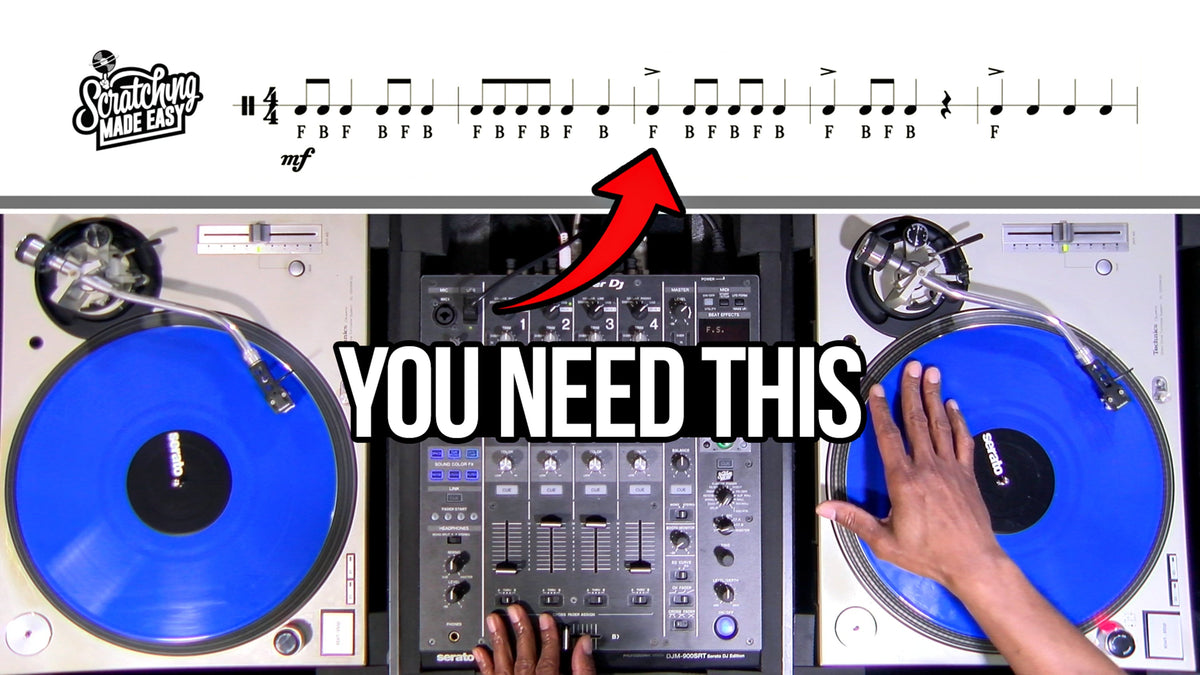
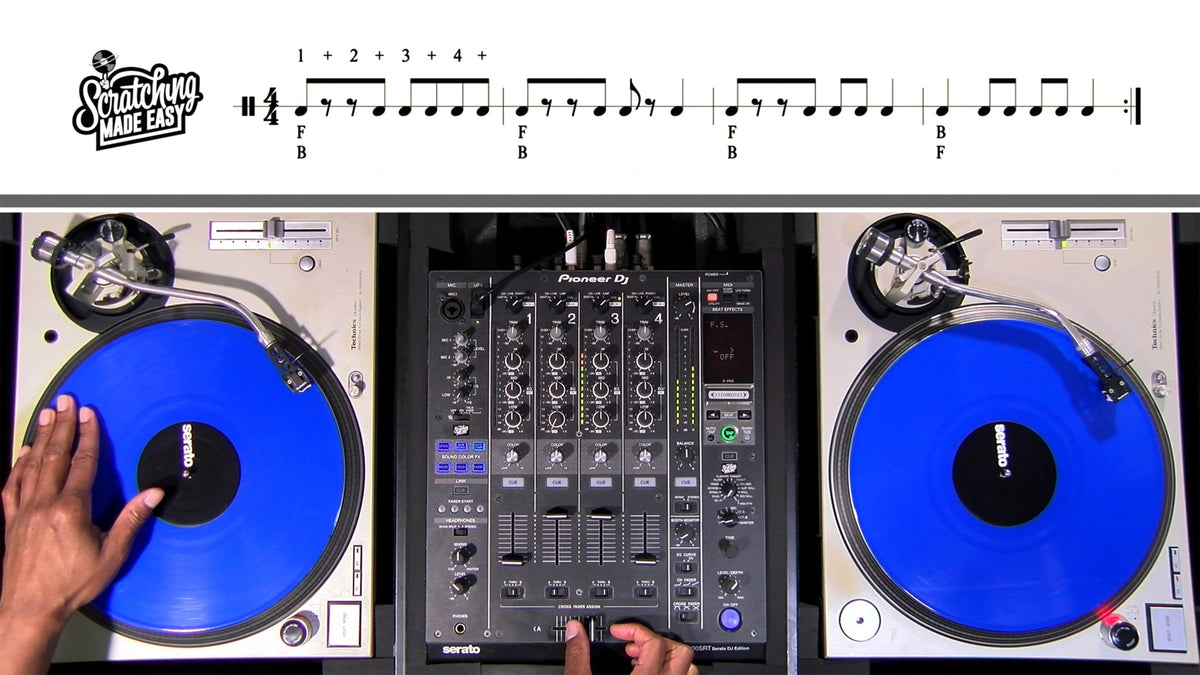
In this video, we introduce syncopation and explain how placing notes off the main beats creates a different rhythmic feel. Using a basic rhythm, we demonstrate how resting on the “and” of beat 1 and coming back in on the “and” of beat 2 gives this particular rhythm its syncopated feel. The lesson also focuses on the importance of staying in time and playing the notes evenly. We demonstrate playing the rhythm forward and backward to help develop timing and control.
Below is the original transcript from the video.
Hey, what's up? This is Ronin from Scratching Made Easy. In this lesson, we're going to talk about one of the musical concepts that started to make things click for me.
At that time, I almost immediately knew that my brother Jason had created a roadmap for scratching, and I understood the notation, but this was the point in the learning process where I began to feel what I was reading. That's because the rhythms I was working on were syncopated.
Syncopation is where we place notes off the main beats to create a different rhythmic feel. And it turns out, this was the feeling I had been looking for. Let's check out the rhythm first, then we'll dive in a little deeper.
All right, here we go.
Example 1

What we just played is a basic rhythm that gives you a starting point for learning syncopation. Let's take a closer look at the rhythm and make this easier to understand. In the first three measures, we rest on the “and” of beat 1, and we come back in on the “and” of beat 2. That pause is what gives this rhythm its syncopated feel.
Let's play the rhythm again, but here's the thing: It's important to come in on time, and we want to make sure that we focus on playing the notes in the following measure as evenly as possible.
All right, here we go.
Example 2
How was that? Our goal was to stay in time and keep the notes even when coming in off the beat. But that might be easier said than done, because after the repeat, we played the rhythm backward. Playing the rhythm backward allows us to work on syncopation in both directions, which also helps to develop our timing control.
It may feel uncomfortable at first, but with time and practice, it will become more natural. I hope this information helps. Hit the like button. Peace.
FAQs
1. How does the rhythm in this lesson create a syncopated feel?
The rhythm creates a syncopated feel by resting on the “and” of beat 1 and coming back in on the “and” of beat 2.
2. Why is timing important when playing syncopated rhythms?
Timing is important when playing syncopated rhythms because you need to be able to come in at the correct time when playing off the beat.
About the Authors
Jason E. Bullock and M. Dwayne Bullock (DjRoninTokyo) are the creators of Scratching Made Easy and the authors of Scratching Made Easy Turntable Method Book 1: A Guide to Scratching. They created a scratch notation system that uses standard musical notation to apply fundamental music concepts to scratching.