
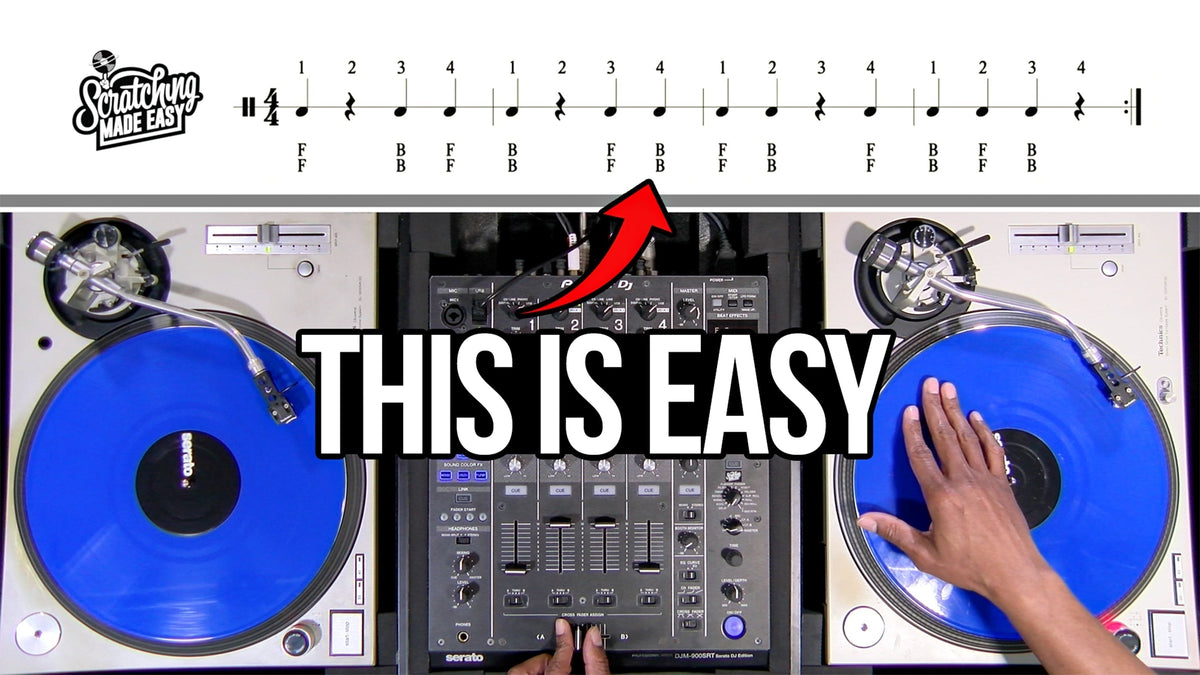
This lesson explains the why behind our teaching method by using quarter notes and quarter rests to show what can be developed through a basic rhythm. We look at timing after a rest and introduce stroke control, showing how the ability to start a rhythm with either a forward or backward stroke gives you more control over how you approach your scratching. The technique used in this lesson is the baby scratch.
Below is the original transcript from the video.
Hey, what’s up? This is Ronin from Scratching Made Easy. In this series we are going to be filling you in on the why behind our method. We will tell you why the things we cover in our videos are so important. So we’re going to be working from our book, Scratching Made Easy Turntable Method.
We’re gonna start off with quarter notes and quarter rests. In other words, we are going to be starting with the basics. Before we dive in, make sure to hit the like button. It helps us get these lessons in front of more people. Okay. I need to point out that the rhythm we’re going to play has a repeat sign. Whenever you see this repeat sign, it means repeat the previous four measures. That means we’re going to play the rhythm two times for a total of eight measures. Got that?
All right, here we go.
Example 1

You’re looking at a basic exercise that has been designed to improve specific skills through focused repeated practice. This basic rhythm allows us to improve on a variety of different things at one time.
One of those things is timing after a rest, which means we are practicing coming in after a rest on time. This is a pretty simple rhythm, but if you haven’t done this before, it is very likely that you will be coming in a little late or a little early. If you’re anything like me when I first started doing this, you may even find yourself forgetting to stop.
If you have good timing, you can play this rhythm consistently without making mistakes and with very little effort. If you’re making mistakes, it means you have something to work on, which is a good thing because with time and effort, these errors can be fixed.
But here’s the catch. If these problems are being revealed by such a basic rhythm, it means that these issues are probably showing up in your scratching, but as I said before, all this can be fixed.
Let’s keep it moving. I’ll fill you in on what else we’re working on in a minute. All right, here we go.
Example 2
One of the coolest things we’re working on is scratching rhythms that require you to start with a backward stroke. I say this is cool because with this ability, you have control over the direction of your starting stroke when scratching rhythms. We’ll call this stroke control. In other words, you can choose whether the rhythm you play starts with a forward stroke or a backward stroke, which means you are not limited to only starting with forward strokes.
Let’s take a closer look at measures two and four. In these measures, we’re working on scratching backwards on beat one. Just hearing that may not sound like much, but there may be times when you need to start a scratch with a backward stroke in order to play the rhythm you want to play. It may not happen a lot, but when you need that skill, it will be there for you.
I have the perfect example. I was making a mixtape, and I wanted to scratch a track and drop it on beat one, but the rhythm I thought would sound the best required me to start the scratch with a backward stroke. That was the only way I’d be able to release the record on beat one and drop the mix.
Just knowing that some rhythms may require you to start with a backward stroke allows you to actively problem solve and approach your scratching and DJing from a more creative perspective.
But here’s the catch. Having control over how you start your strokes isn’t just important because it gives you options like this. It’s important because of what it develops.
Check out this next video, and I’ll fill you in with the rest of the details. In the meantime, add this rhythm to your practice routine. Try to get in at least 15 minutes a day several times a week. You’ll begin to see improvement in the overall quality of your scratching.
See you next video. Peace!
FAQs
1. What does the repeat sign tell you to do in this exercise?
The repeat sign tells you to repeat the previous four measures. That means you play the rhythm two times for a total of eight measures.
2. Why is practicing a basic rhythm with quarter notes and quarter rests useful?
Practicing a basic rhythm with quarter notes and quarter rests is useful because it can reveal timing problems, including coming in too early or too late after a rest.
About the Authors
Jason E. Bullock and M. Dwayne Bullock (DjRoninTokyo) are the creators of Scratching Made Easy and the authors of Scratching Made Easy Turntable Method Book 1: A Guide to Scratching. They created a scratch notation system that uses standard musical notation to apply fundamental music concepts to scratching.

