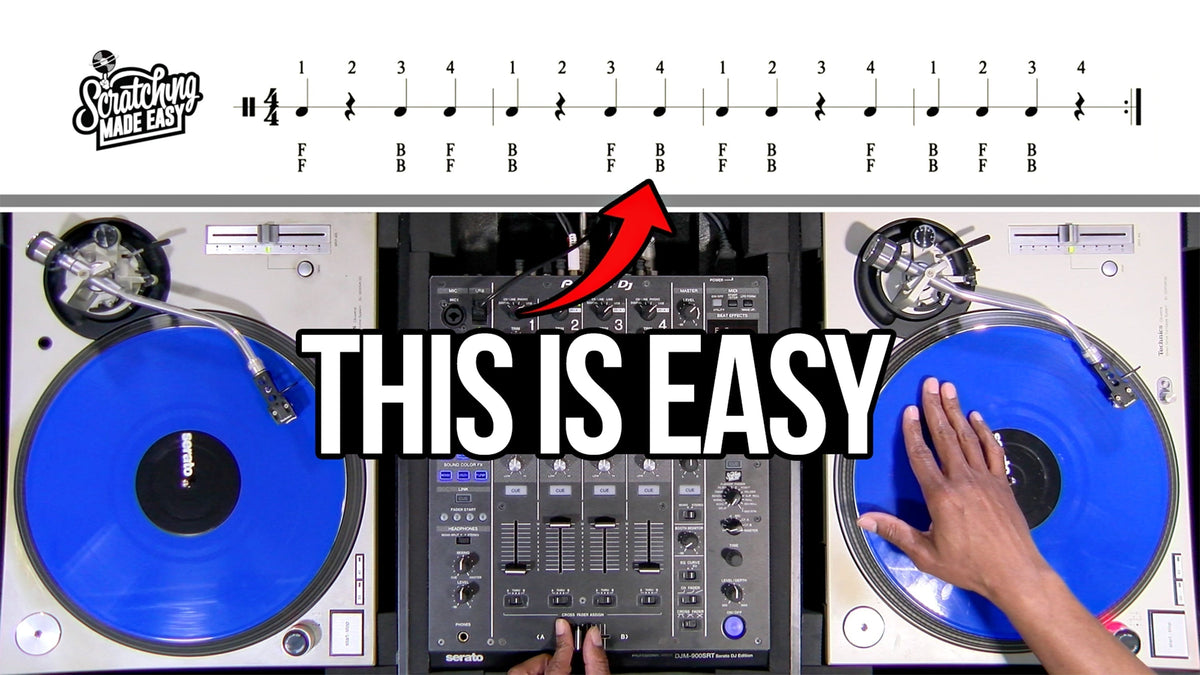
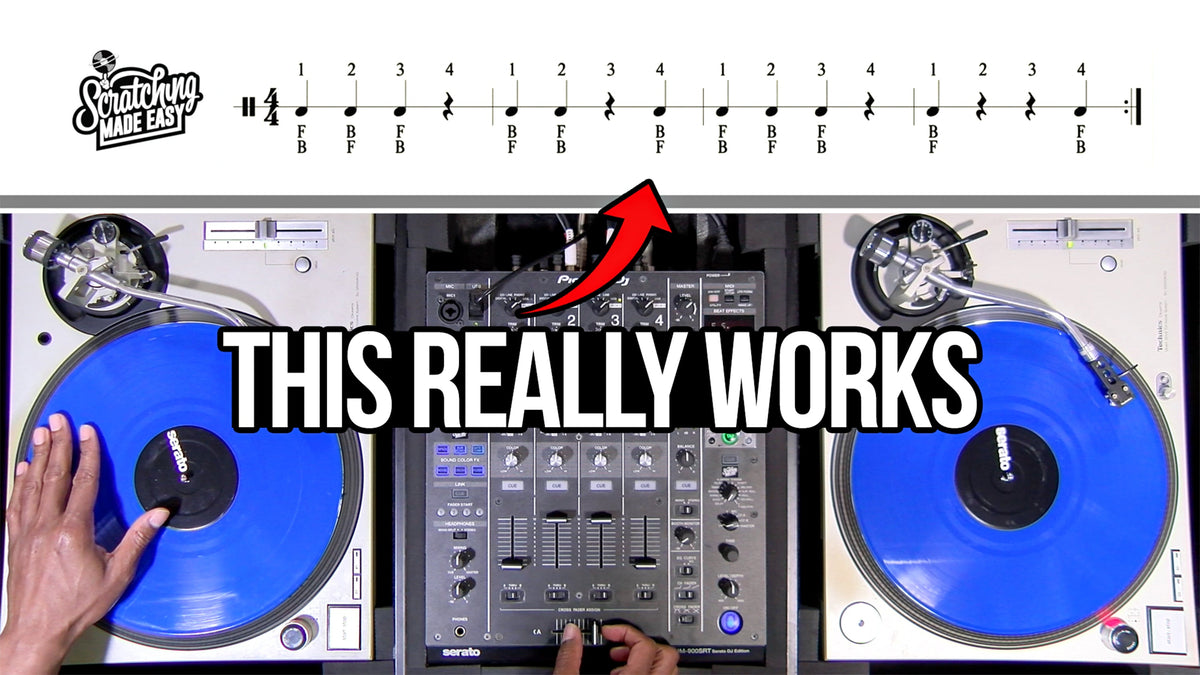
In this lesson, we continue working with quarter notes and quarter rests by changing the location of the rests across four measures. We explain how working the direction of your strokes evenly helps build hand strength and stroke control. We also explain how resting for longer periods reinforces the ability to have control over when and how you come in after a rest.
Below is the original transcript from the video.
Hey, what's up? In this video, we will continue to cover the why behind our method. So we're going to be working from our book, Scratching Made Easy Turntable Method. In the last video, we worked on quarter notes and quarter rests. In this lesson, we're still going to be working with quarter notes and quarter rests, but this time around, we're going to change the location of the rest in each of the first three measures. On top of that, we're going to add rests on beats two and three in measure four. You may have noticed that I still haven't mentioned why we're doing this, but we'll get to that in a minute. Take a sec and hit the like button because it helps us get these lessons in front of more people. All right, here we go.
Example 1

Remember this. This isn’t just about getting through the rhythm. We always want to think about how we’re actually playing. So ask yourself, how was that? Now that we got that out of the way, I have a question for you. Did you pay attention to the direction of your strokes? It's really easy to miss details like this, so I'll fill you in. The first time around, we started everything going forward, but after the repeat, everything got reversed. The question is, what does this mean? It means we're working on our stroke control. In the last lesson, I mentioned the importance of being able to play a rhythm and start with a backward stroke. You may not do it a lot, but when you need to do it, in order to play the rhythm you want to play, you can get it done. But what I didn't mention was what it requires to do it. We need hand strength. In order to be able to have control over the direction of your strokes, we need hand strength. This line is designed to build strength in your hands by working the direction of your strokes evenly. If this is too easy for you, you can step things up and use this opportunity to develop your weak hand. Let's keep it moving. I'll fill you in with a little bit more in a sec. All right, here we go.
Example 2
With this rhythm, we are also working on resting for long periods of time. This reinforces the ability to have control over when and how you come in after a rest. It is important that we have good timing because coming in with bad timing can draw a lot of attention and potentially kill the mood of a set we worked long and hard to create. One of our goals should be to get ourselves to a point where resting for long periods of time isn't an issue at all. If you're struggling with this, don’t worry about it, because I did too. With time and practice, it will work itself out. Get in the reps, and I'll see you in the next video. Peace!
FAQs
1. Why is it important to practice forward and backward strokes evenly?
It is important to practice forward and backward strokes evenly because controlling the direction of your strokes requires hand strength. Working the direction of your strokes evenly helps build that strength.
2. Why is it important to practice resting for longer periods of time?
It is important to practice resting for longer periods of time because it reinforces the ability to have control over when and how you come in after a rest.
About the Authors
Jason E. Bullock and M. Dwayne Bullock (DjRoninTokyo) are the creators of Scratching Made Easy and the authors of Scratching Made Easy Turntable Method Book 1: A Guide to Scratching. They created a scratch notation system that uses standard musical notation to apply fundamental music concepts to scratching.