
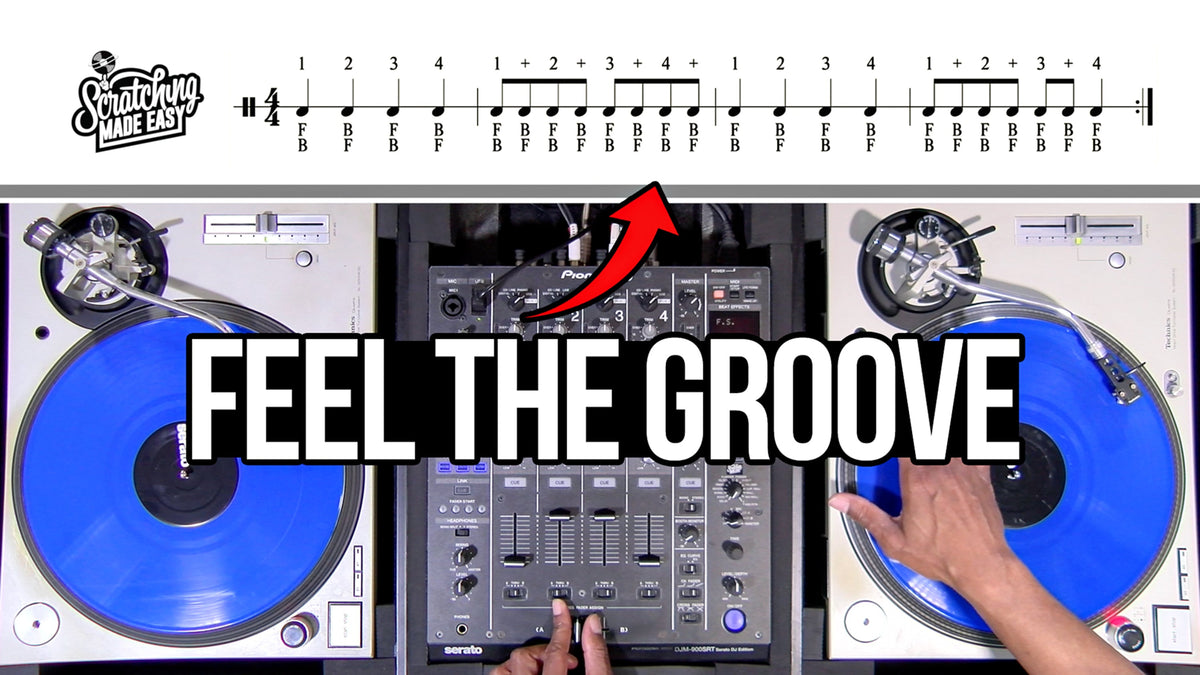
In this lesson, we continue working with quarter notes and eighth notes. We explain why there is a natural tendency to rush eighth notes and how to keep them even and consistent. We also explain how starting eighth notes with forward and backward strokes helps build hand strength and control. Throughout the lesson, we emphasize the importance of understanding note values and counting out loud to help identify and correct timing issues. We explain that the goal is to stay locked into the pulse of the music and feel the groove.
Below is the original transcript from the video.
Hey, what's up? This is Ronin from Scratching Made Easy. In this lesson, we'll be working on quarter notes and eighth notes, and we'll continue working from our book, Scratching Made Easy Turntable Method.
Just a quick reminder and a heads up to those that are new to this. An eighth note equals half a beat, which means that two eighth notes equal the duration of one quarter note. Got that? Do me a favor and keep that in mind, and I'll explain more in a sec.
Alright, here we go.
Example 1

We have to be able to problem solve. Having an understanding of note and rest values makes it easier for us to identify where we are having issues. A strong understanding makes it easier for us to problem solve and fix those issues.
Because eighth notes are half the value of a quarter note, we have a natural tendency to rush. This is normal, and it can be fixed. The key is to be aware of this.
Now that you know this, this time around, try to get the feel for the eighth notes and the quarter notes. Really try to make sure you're staying locked into the pulse of the music. One of our goals is to be able to feel the groove.
All right, let's keep it moving. Here we go.
Example 2
How was that this time around? I know that you tried not to rush the 8th notes, but did you have any issues playing the rhythm after the repeat sign?
After the repeat sign, everything was reversed, so the eighth notes we played started with a backward stroke the second time around. It may feel awkward at first, but this does wonders for building hand strength and control.
Because this requires you to build hand strength, you may need to spend time focusing on starting the 8th notes with a backward stroke and a forward stroke before playing the full rhythm. Once you get the hang of it, put it all together and play the full rhythm.
Keep in mind that the goal is to keep the 8th notes even and consistent. If you are having timing issues, try counting the quarter notes and eighth notes out loud as you play until you get it. This should help you stay focused and locked into the pulse of the music.
I know that it may feel awkward and it isn't necessarily the easiest thing to do, but just know that this is an ongoing process, and with consistent practice, everything will work itself out over time.
I hope this helps. Hit the like button. Peace.
FAQs
1. Is there a natural tendency to rush eighth notes?
Yes. There is a natural tendency to rush eighth notes because they are half the value of quarter notes. This is normal and can be corrected. The key is to be aware of this tendency.
2. Does understanding note and rest values help with problem-solving?
Yes. Understanding note and rest values makes it easier to identify where we are having issues. This is because a strong understanding of note and rest values also makes it easier to problem-solve and fix those issues.
3. Can counting out loud help with timing issues?
Yes. Counting quarter notes and eighth notes out loud while playing can help with timing issues. This is because counting out loud helps us stay focused and locked into the pulse of the music.
About the Authors
Jason E. Bullock and M. Dwayne Bullock (DjRoninTokyo) are the creators of Scratching Made Easy and the authors of Scratching Made Easy Turntable Method Book 1: A Guide to Scratching. They created a scratch notation system that uses standard musical notation to apply fundamental music concepts to scratching.

