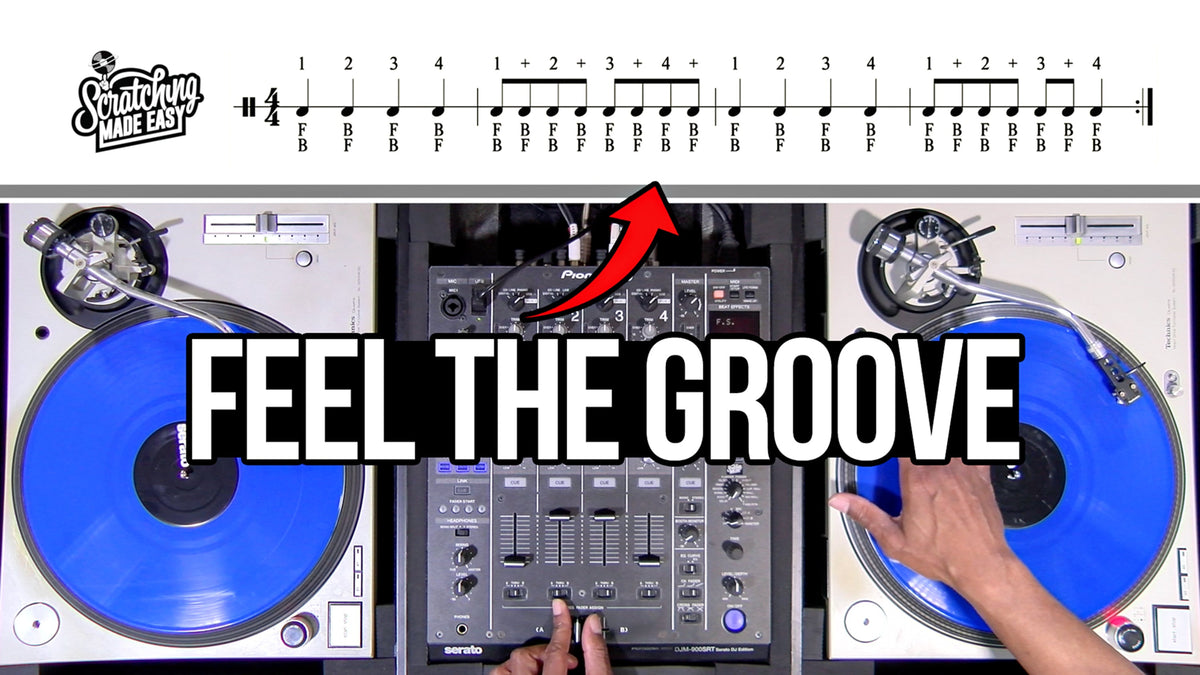
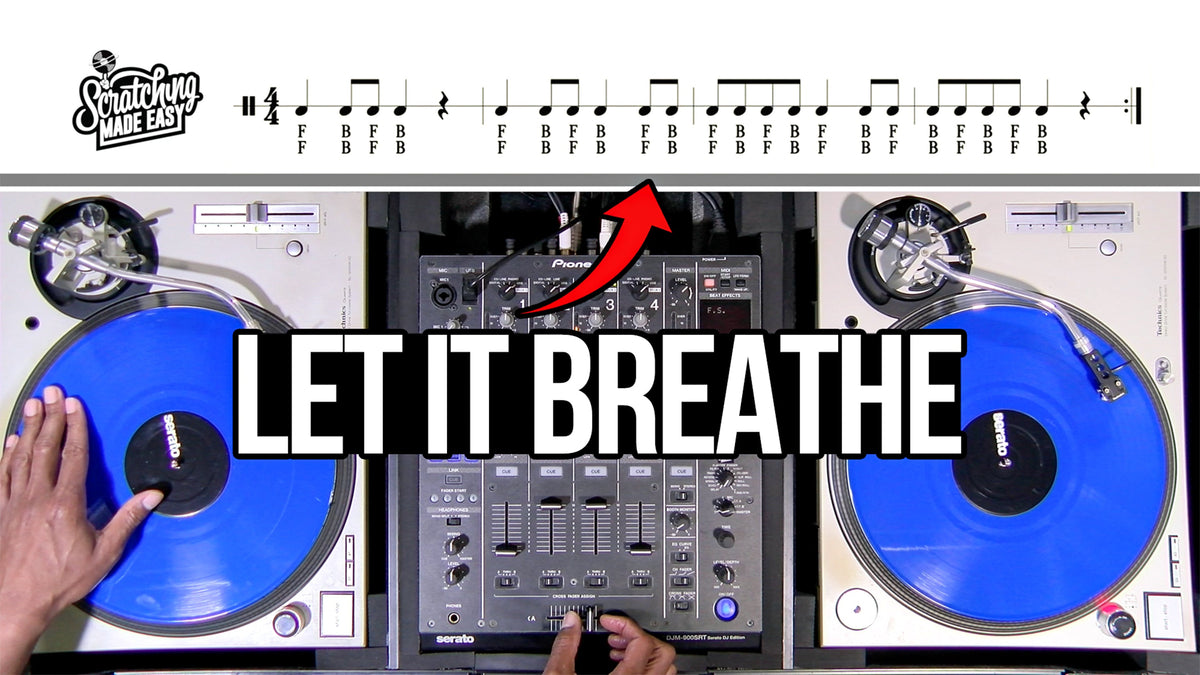
In this lesson, we continue working with quarter notes, quarter rests, and eighth notes while introducing the concept of musical phrasing. We explain how rests help us develop the ability to start and stop scratching on beat, allowing our scratch phrases to breathe instead of scratching continuously. We also explain how a musical phrase can be structured by introducing an idea, expanding on it, and bringing it to an end.
Below is the original transcript from the video.
Hey, what's up? We’re going to continue working through the progression, so this lesson will incorporate quarter notes, quarter rests, and eighth notes. On the surface, this rhythm looks pretty basic, and that's because it is. That’s only looking at it on the surface. Let's keep it moving, and I'll explain more in a sec.
Here we go.
Example 1
When I first went through the process of learning our method, it made me realize that my timing was terrible, and it also revealed what I was struggling with. My standards have changed a lot, but I guess you could say that I was fine when I scratched continuously, but what I struggled with was pausing in between scratches. I couldn't just easily start and stop scratching. In other words, I couldn't let my scratch phrases breathe. Let's take a closer look at the rhythm.
In measures 1 and 4, the quarter rest helps us practice coming in on beat 1 after a rest. For some of us, there can be a natural tendency to keep scratching nonstop, especially when improvising. The rests in measures 1 and 4 help us develop the ability to let our scratch phrases breathe, especially when we improvise. There is even more to this rhythm. We'll get into it after this. Before we do that, hit the like button.
All right, here we go.
Example 2
We love to scratch in our sets, and we want to display our skill set, but at the same time, we don't want to mindlessly scratch nonstop. We want the rhythms we scratch to have some kind of structure that is based on a musical idea. That's right, I said a musical idea. Don't worry about what I just said. I'm going to make this easy.
The musical idea I'm referring to is called a phrase. Look at the first measure. One, two, and three. This is where we introduce the idea. In the second and third measures, we expand on the idea. One, two, and three, four, and one, and two, and three, four, and. Then we end the phrase in the fourth measure. One, and two, and three.
This is a pretty basic rhythm, and basic rhythms are the building blocks we use to build a solid foundation. But here's the catch. You're only looking at one block. Each line was designed for a specific reason. The concepts build on each other, and the best part is, the skills compound over time. See for yourself in the next video. We're covering dynamics.
Peace!
FAQs
1. What is the purpose of the quarter rests in measures 1 and 4?
The purpose of the quarter rests in measures 1 and 4 is to help us practice coming in on beat 1 after a rest and develop the ability to let our scratch phrases breathe.
2. How is the musical phrase structured in this lesson?
In this lesson, the musical phrase is structured by introducing an idea in the first measure, expanding on it in the second and third measures, and ending the phrase in the fourth measure.
About the Authors
Jason E. Bullock and M. Dwayne Bullock (DjRoninTokyo) are the creators of Scratching Made Easy and the authors of Scratching Made Easy Turntable Method Book 1: A Guide to Scratching. They created a scratch notation system that uses standard musical notation to apply fundamental music concepts to scratching.