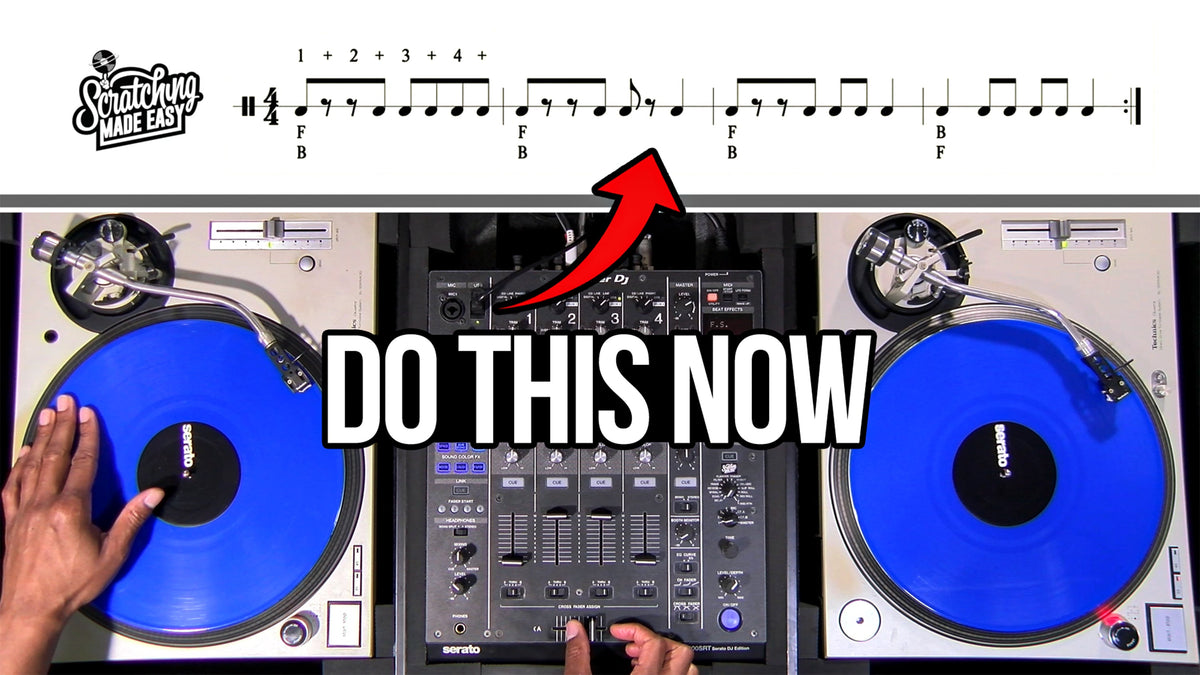
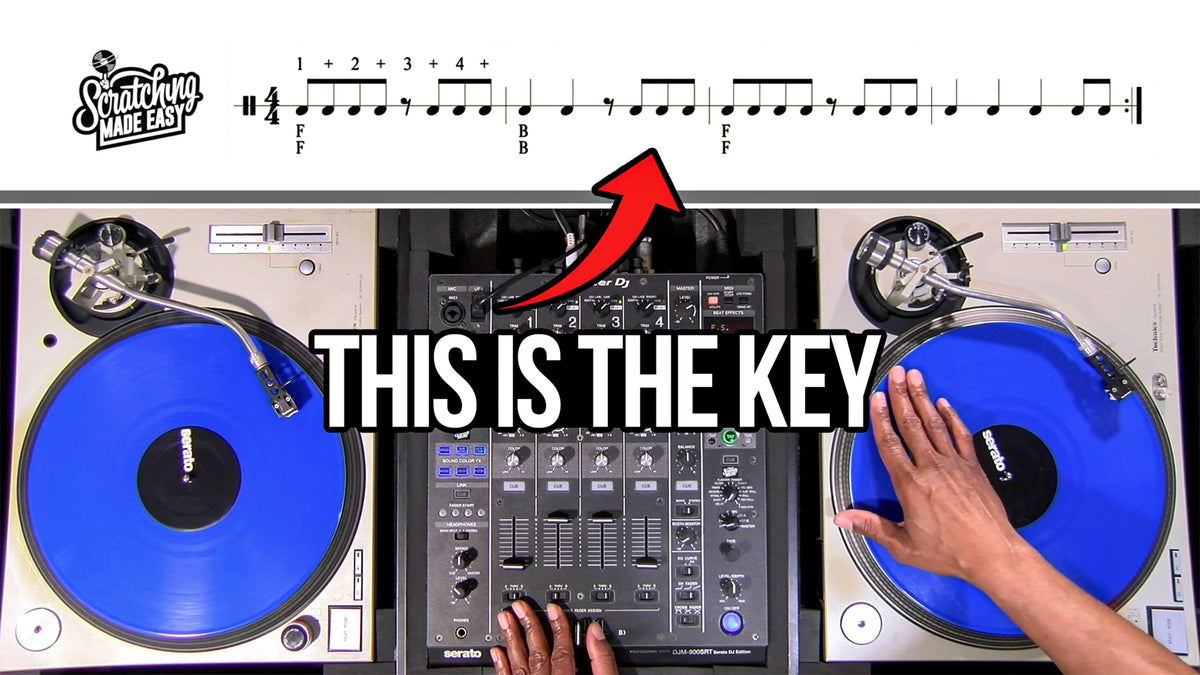
In this lesson, we continue developing syncopation by focusing on subdivision and the timing of eighth notes, quarter notes, and eighth rests. We explain how eighth notes divide quarter notes into two equal parts and how understanding subdivision helps maintain accurate timing.
Below is the original transcript from the video.
Hey, what's up? This is Ronin from Scratching Made Easy. In this lesson, we will continue working from our book and continue developing syncopation.
Before we start, let's take a quick look at the rhythm. In measures 1, 2, and 3, there are eighth rests on beat 3. Remember that eighth notes and eighth rests equal half a beat. So that means we are going to rest for half a beat when we see them. We'll talk more about them in a sec. For now, let's get started.
Alright, here we go!
Example 1

When practicing this rhythm, we need to play the quarter notes and think about the pulse they create. That means we need to think about how the rhythm is subdivided. Don’t worry about the technical term because the concept of subdivision is much easier than it sounds.
Let me explain what I mean. A quarter note gets one beat. There are four quarter notes in one measure. Eighth notes divide a quarter note into two parts. That’s subdivision. It’s that simple. When you scratch the rhythm, think about how the eighth notes fit and feel inside of the quarter notes. In other words, I want you to think about how the quarter notes are subdivided by the eighth notes. Got that?
Alright, hit that like button. Here we go!
Example 2
With this rhythm, we create contrast by combining continuous, flowing eighth notes in measures one and three, and consecutive quarter notes in measures two and four. The rests in measures 1, 2, and 3 help give the rhythm its syncopated feel. This is contrasted by the consecutive quarter notes in measures two and four, which slow the rhythm down.
When I first went through this, when consecutive eighth notes preceded a rest, it was easier for me to feel as well as anticipate the rest on beat three. But I struggled with the timing of the quarter notes in measures two and four. That's because I was in the groove when scratching the eighth notes, but the change to the quarter notes felt almost like a screeching halt. My mind and my hand wanted to keep the eighth notes going.
If you are experiencing this, don't worry about it. It's normal and it can be fixed with repetition. When practicing, make sure to give the full note values to the quarter notes and make sure to rest on beat three, then come back in precisely on the “and” of beat three in measures one, two, and three. If you notice your timing is off, subdivide the quarter notes like we discussed in Rhythm 1. See you in the next video. Peace!
FAQs
1. How many quarter notes are there in a measure of 4/4 time?
There are four quarter notes in a measure of 4/4 time.
2. What is subdivision in music?
Subdivision is dividing a beat into smaller parts. For example, when a quarter note gets one beat, two eighth notes divide that beat into two equal parts.
About the Authors
Jason E. Bullock and M. Dwayne Bullock (DjRoninTokyo) are the creators of Scratching Made Easy and the authors of Scratching Made Easy Turntable Method Book 1: A Guide to Scratching. They created a scratch notation system that uses standard musical notation to apply fundamental music concepts to scratching.